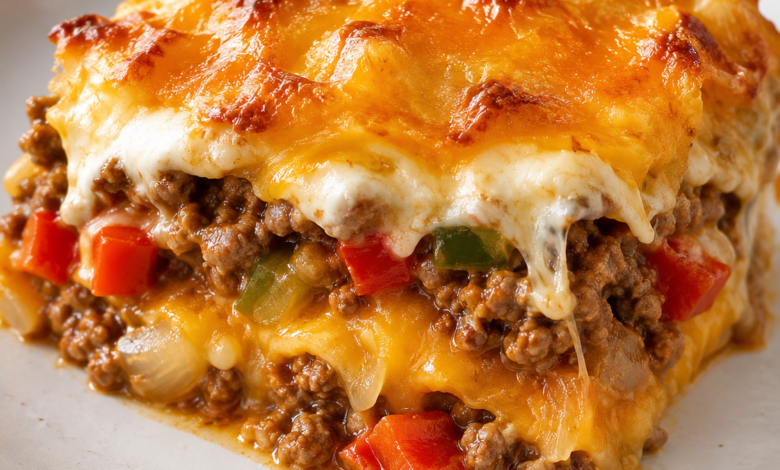
Quick Answer: Cheesy beef lasagna is a hearty baked pasta dish made with seasoned ground beef, red and green bell peppers, creamy ricotta, marinara sauce, and layers of melted mozzarella and cheddar. This homemade version combines tender pasta with a rich beef filling and a golden-brown cheese topping. Simmering the filling before assembly helps prevent watery lasagna, while resting before slicing gives the layers time to settle.
There’s something especially satisfying about cutting into a pan of homemade lasagna and seeing the layers of beef, cheese, and tender pasta underneath that golden, bubbly topping. This version adds colorful bell peppers and sharp cheddar to the familiar combination of ground beef, ricotta, mozzarella, and marinara sauce.
The peppers bring a little natural sweetness, the beef makes each serving hearty, and the three-cheese combination gives the casserole its creamy interior and rich, melted topping. Unlike a traditional Italian lasagna, this American-inspired version uses cheddar for a more pronounced cheesy flavor.
It’s a practical option for family dinners, weekend cooking, or preparing meals ahead of time. If you enjoy comforting baked pasta dishes, you might also like our Cheesy Baked Spaghetti Recipe, which combines seasoned beef and creamy cheese layers.
The key to making this lasagna successful is keeping the beef filling thick enough, cooking the noodles just until al dente, and allowing the finished casserole to rest before serving.
Why This Cheesy Beef Lasagna Recipe Works
This recipe uses familiar grocery-store ingredients, but a few preparation details make a noticeable difference.
Browning the ground beef builds flavor. Cooking the meat before adding the sauce creates savory browned bits that give the filling more depth.
Bell peppers add color and texture. Red and green peppers soften during cooking while retaining enough structure to remain visible in the finished lasagna. Their gentle sweetness balances the rich beef and cheeses.
Ricotta creates a creamy middle layer. Mixing whole-milk ricotta with an egg and Parmesan produces a thick cheese filling that spreads easily between the noodles.
Mozzarella and cheddar serve different purposes. Mozzarella contributes a mild flavor and stretchy melt, while sharp cheddar adds a stronger cheese flavor and helps create the golden-orange topping.
Reducing the meat sauce prevents soggy layers. A filling that is moist but not watery helps the lasagna hold together when sliced.
Finally, baking the lasagna covered before uncovering it allows the interior to heat through without browning the cheese too early.
Recipe Card
| Recipe Details | Information |
|---|---|
| Prep Time | 25 minutes |
| Cook Time | 55 minutes |
| Rest Time | 15 minutes |
| Total Time | 1 hour 35 minutes |
| Servings | 8 generous portions |
| Cuisine | American-inspired Italian |
| Course | Main Course / Dinner |
| Difficulty | Easy to moderate |
| Calories | Approximately 610 per serving (estimate) |
| Oven Temperature | 375°F (190°C) |
| Baking Dish | 9 × 13 inches |
Recipe Description: Tender lasagna noodles layered with savory ground beef, colorful bell peppers, creamy ricotta, marinara sauce, mozzarella, and sharp cheddar, baked until bubbly and golden.
Ingredients You’ll Need
All ingredients are measured using standard US measurements.
For the Beef and Pepper Filling
- 1½ pounds lean ground beef (85–90% lean)
- 1 medium yellow onion, diced
- 1 medium green bell pepper, diced
- 1 medium red bell pepper, diced
- 3 garlic cloves, minced
- 1 tablespoon olive oil
- 2 cups marinara sauce
- 1 teaspoon Italian seasoning
- ¾ teaspoon kosher salt, plus more to taste
- ½ teaspoon freshly ground black pepper
For the Creamy Cheese Layer
- 15 ounces whole-milk ricotta cheese
- 1 large egg
- ½ cup freshly grated Parmesan cheese
- ½ teaspoon garlic powder
- ¼ teaspoon black pepper
For the Lasagna Layers
- 9 regular lasagna noodles, cooked according to package directions
- 2 cups shredded low-moisture mozzarella cheese, divided
- 2 cups shredded sharp cheddar cheese, divided
- 1 tablespoon softened butter or a little olive oil, for greasing the baking dish
Important Ingredient Notes
Ground beef: Lean ground beef provides a hearty filling without releasing excessive grease. If your beef produces more fat than expected, drain the excess before adding the vegetables.
Bell peppers: Use one red and one green bell pepper for the intended flavor and appearance. Cutting them into similar-sized pieces helps them soften evenly.
Marinara sauce: Choose a sauce you already enjoy. Since marinara contributes much of the filling’s seasoning, taste the mixture before adding extra salt.
Whole-milk ricotta: This produces a creamy filling that spreads between the pasta layers. Very watery ricotta may make the lasagna softer than intended.
Mozzarella: Low-moisture mozzarella is suitable for baked casseroles because it melts well without releasing as much liquid as fresh mozzarella.
Sharp cheddar: Cheddar gives this recipe its richer flavor and golden topping. Shredding it from a block can help it melt smoothly.
Lasagna noodles: Use regular noodles rather than oven-ready noodles because the recipe calls for cooking them before assembly.
Equipment Needed
You won’t need specialty kitchen equipment.
- 9 × 13-inch baking dish
- Large skillet
- Large pot for boiling pasta
- Colander
- Medium mixing bowl
- Wooden spoon or spatula
- Sharp knife and cutting board
- Measuring cups and spoons
- Aluminum foil
A wide spatula is also helpful for lifting individual portions without disturbing the layers.
How to Make Cheesy Beef Lasagna
Follow these instructions in order, paying particular attention to the meat sauce consistency and the final resting time.
Step 1: Preheat the Oven
Preheat your oven to 375°F (190°C).
Lightly grease a 9 × 13-inch baking dish with softened butter or olive oil.
Coating the dish helps prevent the pasta and cheese from sticking to the bottom and makes serving easier.
Step 2: Cook the Lasagna Noodles
Bring a large pot of salted water to a boil.
Add the lasagna noodles and cook according to the package directions until just al dente.
Drain the noodles and arrange them flat on a lightly oiled surface.
They should be flexible but still hold their shape. Overly soft noodles are more likely to tear during assembly and become mushy after baking.
Step 3: Brown the Ground Beef
Heat 1 tablespoon olive oil in a large skillet over medium-high heat.
Add the ground beef and cook for 6–8 minutes, breaking it into small crumbles with a wooden spoon.
Continue cooking until thoroughly browned with no pink remaining.
If necessary, drain excess fat while leaving enough moisture to keep the meat tender.
Browning the beef before adding the sauce creates a more flavorful filling.
Step 4: Cook the Bell Peppers and Onion
Add the diced yellow onion, green bell pepper, and red bell pepper to the skillet.
Cook for 5–7 minutes, stirring occasionally.
The onions should become translucent, while the peppers should soften slightly without losing their shape completely.
Allowing some of their moisture to evaporate at this stage helps prevent the finished lasagna from becoming watery.
Step 5: Add the Seasonings and Marinara Sauce
Stir in the minced garlic, Italian seasoning, kosher salt, and black pepper.
Cook for approximately 30 seconds, just until the garlic becomes fragrant.
Add the marinara sauce and reduce the heat to medium-low.
Simmer uncovered for 5–7 minutes, stirring occasionally, until the sauce thickens slightly and coats the beef.
The mixture should remain moist and spoonable, without excess watery liquid collecting in the skillet.
Step 6: Make the Creamy Ricotta Filling
In a medium mixing bowl, combine:
- Whole-milk ricotta cheese
- Large egg
- Freshly grated Parmesan cheese
- Garlic powder
- Black pepper
Stir until the ingredients are evenly combined.
The finished mixture should be creamy but thick enough to spread over the noodles without running.
This layer gives the lasagna its soft, creamy texture between the beef and pasta.
Step 7: Assemble the Lasagna Layers
Spread a few spoonfuls of beef sauce across the bottom of the prepared baking dish.
Reserve a little sauce for the top, then arrange the remaining ingredients in the following order.
| Layer | Ingredient |
|---|---|
| 1 | Thin layer of beef sauce |
| 2 | 3 cooked lasagna noodles |
| 3 | Half the remaining beef-and-pepper filling |
| 4 | Half the ricotta mixture |
| 5 | ½ cup mozzarella + ½ cup cheddar |
| 6 | 3 cooked lasagna noodles |
| 7 | Remaining beef-and-pepper filling |
| 8 | Remaining ricotta mixture |
| 9 | ½ cup mozzarella + ½ cup cheddar |
| 10 | Final 3 cooked lasagna noodles |
| 11 | Reserved beef sauce |
| 12 | 1 cup mozzarella + 1 cup cheddar |
Spread each layer evenly without pressing it down too firmly.
Keep the upper layer of noodles covered with sauce before adding the final cheese topping. This helps prevent the exposed pasta from drying out.
Step 8: Bake the Lasagna Covered
Cover the baking dish with aluminum foil, tenting it slightly so the cheese doesn’t stick.
Bake for 30 minutes.
Keeping the dish covered during the first stage allows heat to move through the lasagna while protecting the cheese topping from excessive browning.
Step 9: Brown the Cheese Topping
Carefully remove the foil.
Continue baking uncovered for approximately 15 minutes, until the cheese is bubbly and develops golden-brown spots.
The edges should be lightly browned, and the topping should look fully melted rather than dry.
Check that the center reaches 165°F (74°C), since the casserole contains an egg-based ricotta filling.
If the topping has browned before the center reaches that temperature, cover it loosely with foil and continue heating until done.
Step 10: Rest, Slice, and Serve
Remove the baking dish from the oven and let the lasagna rest for 15 minutes.
This is an important finishing step. The melted cheese and hot filling need time to settle before slicing.
Cut into eight generous portions and lift each piece carefully with a wide spatula.
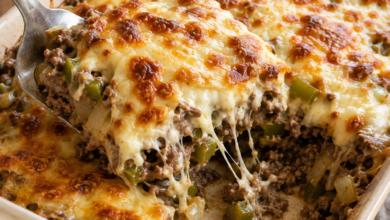
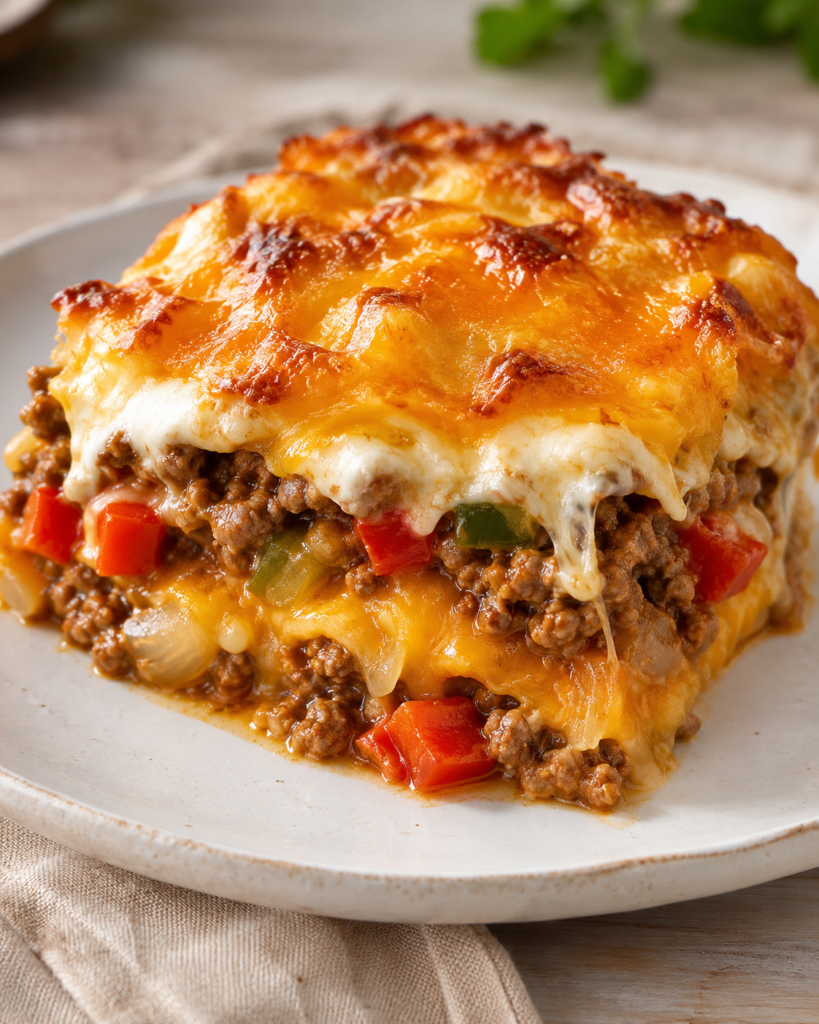
The finished lasagna should have a golden cheese topping, creamy white cheese layers, tender pasta, and a hearty beef filling with visible red and green peppers.
Chef Tips
These practical tips can make the recipe easier to prepare and serve.
- Cut the peppers evenly. Pieces around ½ inch distribute well through the filling without disappearing during cooking.
- Avoid overcrowding the skillet. A crowded pan can trap moisture and make browning the beef more difficult.
- Drain excess beef fat. Too much fat can leave an oily layer in the bottom of the casserole.
- Keep the filling thick. Simmering away excess liquid is one of the most effective ways to maintain distinct layers.
- Use freshly shredded cheese when possible. It generally melts more smoothly than packaged shredded cheese.
- Spread ricotta gently. Small spoonfuls are easier to distribute over noodles than one large mound.
- Protect the noodles. Make sure pasta near the edges is covered with filling or sauce to prevent dry, hard corners.
- Don’t compact the layers. Pressing down too firmly can make the lasagna dense and squeeze the filling toward the sides.
- Watch the final browning stage. Oven performance varies, so check the topping near the end of baking.
- Use a wide serving spatula. Supporting the entire portion from underneath helps prevent the layers from sliding apart.
Common Mistakes to Avoid
1. Using a Watery Meat Filling
What happens: Excess liquid collects in the bottom of the pan, and the slices lose their shape.
Why: The vegetables and sauce release more moisture than necessary.
Prevention: Simmer the filling uncovered until slightly thickened.
Possible fix: If the filling is still watery before assembly, continue simmering briefly to reduce the liquid.
2. Overcooking the Noodles
Soft noodles can become mushy during baking.
Cook them just until al dente, drain carefully, and lay them flat so they don’t tear or stick together.
3. Leaving Too Much Grease in the Beef
Excess fat can create an oily finished casserole.
Drain unnecessary grease after browning, but avoid drying out the meat.
4. Using Watery Ricotta
Extra moisture in the ricotta filling can weaken the layers.
Choose thick whole-milk ricotta and avoid adding extra liquids to the cheese mixture.
5. Forgetting to Reserve Sauce for the Top
An uncovered upper pasta layer may become hard or dry.
Reserve enough beef sauce to lightly cover the final noodles before adding mozzarella and cheddar.
6. Browning the Cheese Too Early
If the casserole is baked uncovered from the beginning, the surface may become overly dark before the center heats through.
Keep the dish covered for the first 30 minutes, then uncover it for the final browning stage.
7. Cutting the Lasagna Immediately
Freshly melted cheese and hot sauce can make the layers slide apart.
Allow the full 15-minute rest before cutting. This improves the shape without making the dish cold.
Variations
The following variations change the original recipe, so expect small differences in flavor or texture.
Spicy Cheesy Beef Lasagna: Add ½ teaspoon crushed red pepper flakes to the beef filling. You can also substitute pepper jack for part of the cheddar for a sharper, spicier cheese flavor.
Extra Creamy Lasagna: Replace ½ cup ricotta with ½ cup softened cream cheese. This creates a denser, richer cheese layer with a slightly tangy flavor.
Vegetable-Rich Version: Add 1 cup finely chopped mushrooms to the ground beef mixture. Cook until their moisture evaporates before adding marinara sauce.
Small-Batch Lasagna: Halve the ingredients and prepare the recipe in an approximately 8-inch square baking dish. Begin checking for doneness earlier, since smaller portions may heat through more quickly.
Storage Instructions
Lasagna makes practical leftovers because individual portions can be refrigerated or frozen.
Room Temperature
Do not leave cooked lasagna at room temperature for longer than 2 hours.
If the surrounding temperature exceeds 90°F, refrigerate it within 1 hour.
Refrigerator
Transfer leftover portions to shallow, airtight containers and refrigerate promptly.
Store at 40°F or below for 3–4 days.
Freezer
Wrap cooled individual portions tightly and place them inside freezer-safe containers or bags.
Freeze for best quality within 2–3 months.
The lasagna can remain safe longer when continuously frozen at 0°F, but the pasta and cheese texture may gradually deteriorate.
Best Storage Containers
Shallow glass or food-safe plastic containers work well for refrigerated leftovers.
For freezing, use airtight freezer-safe containers or wrap individual portions securely to reduce freezer burn.
How to Reheat Beef Lasagna
Oven — Best for Preserving Texture
Preheat the oven to 350°F (175°C).
Place a portion of lasagna in an oven-safe dish and cover loosely with foil.
Heat for approximately 15–25 minutes, depending on the size and starting temperature of the portion.
Check that the center reaches 165°F (74°C).
Covering helps retain moisture while warming the pasta and cheese evenly.
Microwave — Best for Convenience
Place an individual portion on a microwave-safe plate.
Cover loosely and microwave in 60–90-second intervals, checking between intervals.
Continue reheating until the center reaches 165°F.
Let the portion stand briefly before eating so the heat can distribute more evenly.
Reheating Frozen Lasagna
For more even reheating, thaw frozen portions overnight in the refrigerator before following the oven method.
Avoid repeatedly reheating the same portion, since this can dry out the pasta and cheese.
Make-Ahead Instructions
This beef lasagna can be assembled before baking, making it convenient for busy days.
Up to 24 hours ahead: Assemble the lasagna in the baking dish, cover it tightly, and refrigerate.
When ready to cook, remove the covering used for storage and replace it with loosely tented foil suitable for baking.
Bake according to the recipe, allowing additional covered baking time if needed because the casserole starts cold.
Check the center with a food thermometer to make sure it reaches 165°F.
You can also prepare the beef filling ahead of time and refrigerate it in a covered container. This makes assembly easier when you’re ready to cook.
Serving Suggestions
Cheesy beef lasagna is rich and filling, so simple side dishes work particularly well.
Green salad: Crisp lettuce and a light vinaigrette provide a refreshing contrast to the cheese.
Garlic bread: A classic choice for serving with tomato-based pasta dishes.
Roasted broccoli: The lightly browned vegetables add texture without competing with the lasagna.
Green beans: Steamed or roasted green beans are a simple accompaniment.
Sautéed zucchini: Its mild flavor pairs well with the beef and marinara filling.
For drinks, unsweetened iced tea, sparkling lemon water, or plain water with fresh citrus are easy choices.
If you’re planning a comfort-food dinner menu, our Slow Cooker Beef and Noodles is another hearty family meal worth exploring.
Frequently Asked Questions
Can I put bell peppers in beef lasagna?
Yes. Bell peppers work well with ground beef, onions, and tomato sauce. Cooking them before assembly softens their texture and removes some moisture. Red peppers add mild sweetness, while green peppers provide a more pronounced vegetable flavor.
Can I use cheddar cheese in lasagna?
Yes. Although mozzarella and ricotta are more common in traditional lasagna, cheddar works well in American-style versions. Sharp cheddar adds stronger flavor and contributes to the golden-orange cheese topping.
How do I prevent watery lasagna?
Cook the beef and vegetables until excess moisture evaporates, then simmer the marinara filling until slightly thickened. Use thick ricotta and avoid adding unnecessary liquids. Resting the lasagna before slicing also helps the layers hold together.
Should I cover lasagna while baking?
For this recipe, cover the lasagna with tented foil for the first 30 minutes. Remove the foil and bake for approximately 15 more minutes to brown the cheese. Make sure the center reaches 165°F.
Why does my homemade lasagna fall apart?
Lasagna can fall apart when the filling contains too much liquid or when it is sliced immediately after baking. Allowing the casserole to rest for 15 minutes helps the hot cheese and filling settle.
Can I make beef lasagna the night before?
Yes. Assemble the lasagna up to 24 hours in advance, cover tightly, and refrigerate. Bake when ready, adding time if necessary to heat the cold center thoroughly.
Can I freeze cheesy beef lasagna?
Yes. Cool the lasagna promptly, divide it into individual portions, and freeze in airtight containers. For the best texture, use frozen portions within 2–3 months.
What is the best way to reheat leftover lasagna?
The oven is a good choice for preserving texture. Reheat covered at 350°F until the center reaches 165°F. For quicker reheating, use the microwave in short intervals.
What cheese makes lasagna creamy?
Ricotta creates the creamy middle layer, while mozzarella provides a smooth, stretchy melt. This recipe also uses Parmesan for savory flavor and sharp cheddar for its distinctive richness.
Key Takeaways
- Browning the ground beef and cooking the peppers before assembly creates a flavorful filling.
- Simmering the sauce until thickened helps prevent watery lasagna.
- Ricotta provides creaminess, mozzarella adds stretch, and sharp cheddar gives the dish its golden cheesy topping.
- Baking covered before uncovering helps the casserole cook evenly while developing a lightly browned surface.
- Letting the lasagna rest for 15 minutes improves slicing, and leftovers can be refrigerated for 3–4 days or frozen for later.
Quick Recipe Summary
Cheesy beef lasagna with bell peppers is an American-inspired baked pasta casserole featuring ground beef, red and green bell peppers, onions, marinara sauce, ricotta, mozzarella, cheddar, and Parmesan. The beef and vegetables are cooked together before being layered with tender lasagna noodles and creamy cheese filling. The casserole bakes at 375°F, first covered and then uncovered until the topping becomes golden and bubbly. Resting for 15 minutes before slicing helps the layers maintain their structure. This recipe makes eight generous portions and can be assembled ahead of time, refrigerated, or frozen for convenient family meals.
More Comfort Food Recipes from Botainfo
If you enjoy hearty beef and pasta dinners, explore these related recipes:
- Creamy Crockpot Lasagna Soup — A slow-cooker soup with familiar lasagna flavors.
- Cheesy Baked Spaghetti — Another family-style baked pasta dish with beef and melted cheese.
- Slow Cooker Beef and Noodles — Tender beef and noodles in savory gravy.
- Bacon Cheeseburger Noodle Bake — A cheesy ground beef and pasta casserole.
- Broccoli Cheddar Lasagna Soup Without Heavy Cream — A creamy vegetable and pasta soup.
Food Safety References
For additional information about safe food handling, refrigerated leftovers, and reheating, consult the USDA Food Safety and Inspection Service.
Recipe development disclosure: This recipe was developed from a visual food reference using culinary principles and realistic ingredient proportions. It has not been physically kitchen-tested by the Botainfo Editorial Team. Cooking times, texture, and final appearance may vary depending on the ingredients and equipment used.